Showing posts with label PC. Show all posts
Sunday, January 12, 2014
Game Dev Tycoon Review
I have to say that I like simulation games, though I am not usually very good at them. Recently, during the Steam Holiday Sale, I was able to pick up Greenheart Games' Game Dev Tycoon for next to nothing. That was great for me, but possibly less great for the developer so I thought I would do my part by posting a review.
Game Dev Tycoon, as the name implies, has you starting out a new game development company in your garage. You get to choose what platforms to make your games on, what genre and type of game as well as how much money and time you will put into the various aspects of the game. All of this is done with a simple pop-up menu system while you look down into your fledgling game studio.
All of the usual hallmarks of a tycoon simulation are there. You have the tech tree that you can research to unlock new technologies for your game engines (surround sound, cut-scenes, dialogue trees, full-motion video, etc.). You also are responsible for hiring, developing and/or firing your staff as your company grows. You choose what type of booth you want at the annual convention and how you want market your game. You also decide when the games you develop are finished and ready to ship.
To make a game in Game Dev Tycoon, you select the genre, platform and type of game you want. What you can choose depends on what systems you have licenses to, what you have researched and what type of game engines you have developed for your team to code on. As you make games, you will gain research points that can be spent (along with the money you make selling your games) on training your staff or researching the latest and greatest technology. You also are responsible for balancing your staff on projects (once you start doing medium or large projects) to ensure no one is over-allocated or burnt out.
Once a game is finished, you release it and then get to see the reviews come in. The reviews are all a simple phrase and a number from four different game reviewers. The higher the review score the more-likely you will have a breakout hit that can make millions for your company. If you have a string of poor games or need money, you can also take on contract work for some quick cash to keep your studio afloat. You can also work with a publisher on a game, which may give you access to a larger audience but at the expense of them taking the lion share of the revenues and dictating what type of game you have to make.
I really liked how the game systems that you can develop for are modeled on real-life systems. That does have a drawback of making Game Dev Tycoon a little easier if you know your console history and which platforms to avoid. It is also always suspenseful waiting to see what rating your new game will get, hoping for a blockbuster. I still haven't figured out exactly what makes the reviewers like a game most as each game you develop has to have the right genre and style for the platform as well as a lot of design and technology invested by your team to seem to get a lot of customers but that may not result in a highly rated game.
If you like to do some high-level managing of a game studio and call the shots, Game Dev Tycoon is an easy to learn & play and fun way to do that. It is also relatively cheap whether on sale or not (typically $9.99 on Steam). I give Game Dev Tycoon 4 Mick Happies. Now I have to get my studio, Entertainbert, back to making PoE 2.
Sunday, November 10, 2013
Hearthstone: Heroes of Warcraft Beta Review
In honor of Blizzcon 2013, I thought I would share my thoughts on Hearthstone: Heroes of Warcraft, Blizzard's in-development digital-only collectable card game for Mac, PC, iOS and Android. I was lucky enough to score a closed beta code to access the game prior to release and have been enjoying kicking the tires on this free-to-play tactical/strategy game. As noted in other posts, I have some experience with the CCG genre from Magic the Gathering to Wheel of Time and others, so I may use some jargon in the rest of this review.
Earlier this Summer, Blizzard announced what I think is their first free-to-play offering, Hearthstone. At it's heart, Hearthstone is the digital evolution of collectible card games (though not the first given the release of Mohjang's Scrolls). The object of the game is to use a deck of 30 cards to defeat a computer or human opponent by reducing their avatar (a character from Warcraft) to zero life.
Each player in Hearthstone starts the game with the tutorial where you get to try the game as one of the nine avatars that are available in the game. Each avatar has a unique set of cards (as well as shared cards) they can use to build their deck - during the tutorial the deck is pre-set. To play you start with a hand of 3 cards (4 if you go second) and "cast" cards from your hand using the mana you get from mana crystals. Each turn you can take as many actions as you like from casting cards from your hand to attacking with minions (creature cards) or using your avatar's special ability (such as a fireball that does 1 damage to a specific target for 2 mana crystals). Creatures have the usual health/attack attributes as well as abilities that trigger when they are cast or based on certain actions in the game. There are even abilities and cards that give your avatar attack and armor allowing them better protection and the capability to attack your opponent directly.
Unlike other CCG, the resources used to cast cards is relatively fixed starting with 1 mana crystal and gaining another every turn until you reach a maximum of 10. This takes the randomness of drawing resource cards from your deck out the game, meaning that decks are smaller (30 cards) and games are typically played much faster than other card games (5 - 10 minutes on averages - sometimes longer). It also allows the player to focus on tuning their deck to the strategy they want to follow.
At the start of the game you have a single avatar to play and a deck of 30 basic cards. As you play, you gain experience that levels up your avatar, unlocking new basic cards until by level 10 you have unlocked all basic cards for that avatar. There are 3 play modes, Practice, Play and the Arena to choose from. When first starting out, you can play practice games against the AI and when you beat a given avatar opponent the first time you unlock that avatar and deck to play. Practice is also the place where you can test decks before trying them against human opponents.
The Play mode is 1 v 1 games against human opponents that the game tries to match you agains skill wise for a competitive game. You gain experience from those games as well and can also earn medals over time to help rank you for future matches. In the Arena, you pay gold (the in game currency) to get to basically build a sealed deck where you pick 30 cards one at a time from a selection of a few cards each pick. You then play with that deck until you have lost 3 times. The more game wins you have with your Arena deck before losing the last time, the bigger reward you unlock at the end. Also, Arena games do not have to all be played at the same time, allowing you to start an Arena game and then go back to it another day if you don't have time to keep playing.
The reward system, including Arena rewards, is based around gold, which can be used to start Arena games or to buy new packs of cards. Arena rewards can also offer packs of cards, gold or arcane dust. Each pack of cards (also available for real money purchase) give you 5 new Expert cards for your collection with at least one of them being guaranteed rare, epic or legendary (more valuable). The arcane dust reward can be used to upgrade cards into other, often more powerful cards - Expert common, rare and epic cards can also be disenchanted (destroyed) for arcane dust. All of which can be used to expand your card collection and thus allow you to build more powerful decks.
The gameplay of Hearthstone will be familiar to any Magic the Gathering player while removing a little of the randomness that game suffers from due to the reliance on land cards for resources. All of the common strategies are present in Hearthstone - overwhelming creatures, control, card advantage, removal, etc. What makes Hearthstone a potentially great game is how simple it is to pick up and play alongside all of the depth of deck building, avatars, card crafting etc. The crafting mechanic, the ability to always find a human opponent and the quick game play is great.
How Hearthstone will stand out from other games like it will be the cross-platform access that is coming. The game seems built for a touch interface. I imagine I will be playing a game or two before bed every night once the iOS tablet app is available. During the beta I have also found no need to pay for anything as long as you don't mind grinding out games to earn gold (you get gold for every 3 competitive game wins against a human opponent) or completing daily quests (win a few games with a certain avatar deck or kill a specific number of minions). The free-to-play model (as implemented right now in the game) seems to fit very well, where you can wait to get more powerful cards/decks if you have the patience or, for those who want to be more competitive fast, you can spend to get the cards you need now. Hearthstone will be a hit and if you like physical or digital card games, pick it up immediately when it becomes available to you. Hearthstone gets 5 Mick Happies. See you in the Arena.
Wednesday, April 17, 2013
Path of Exile Open Beta Review
Path of Exile (PoE) from Grinding Gear Games is one of the
latest action RPG games available to gamers. The catch here is that PoE, when officially released, will be
free to play on Windows-based PCs. To monetize the game they are selling
different graphical effects or pets for your characters, nothing required to
play the game. Even better, PoE is playable
right now through an Open Beta.
Having completed and reviewed Diablo 3 previously here, I have a pretty good sense of what the
current generation of action RPGs is like. PoE
has a set of six characters to choose from to explore the world of
Wraeclast. You can choose from the
Templar, Witch, Duelist, Ranger, Marauder and Shadow. Each of the characters
share a common skill tree but start in their own special area of the skill tree
so each is distinct in their specialties early in the game and aligned with one
of the three main stats of Strength, Dexterity or Intelligence. More on the
skill tree below. The story starts with you winding up stranded on Wraeclast, a
“forsaken” land where exiled prisoners are dropped as punishment for their
transgressions.
The world of Wraeclast being a land of outcasts has
developed an economy based on items rather than money. Identify scrolls
(Scrolls of Wisdom) are the coin of the realm in the start town along with a
few other novel items. This means that trading items found (even the
non-magical items that can be found most anywhere) is beneficial to you in the
early game. When in town you will find other players as well as NPCs
(non-player characters) you can trade with and quests to try.
At its heart, PoE is
about exploring the world, killing monsters and getting loot. The graphics are
well done and the attack, skill and spell effects look great. I am playing on
an old Windows XP laptop running an AMD Athlon dual-core 2.1 GHz processor with
3GB of RAM and while I do experience hiccups and lag at times, the game is
certainly playable. Unlike other games where each class may have specific
spells or skills, PoE uses a common
skill tree of passive abilities that modify your stats and capabilities with
items and skill gems. These gems can be added to socketed items worn/used by
your character to that provide your character with additional skills like lightning
or fire traps. Items also can be modified using special orbs to add extra
magical abilities or make a common item magical.
All of the usual aspects of an action RPG are here good
visuals, quests, lots of item variety (normal, magic, rare, etc.). Some of the
more novel bits are quite nice like the orbs and lack of a gold currency. Note
that the game is still in beta despite all of the polish and hopefully will
only get better. One thing that I have found annoying is the lack of being able
to right click on an item in the inventory to move it to a vendor to sell it.
If that is all I have to complain about in a game in beta, they must be doing
something right. Since it’s free, go sign up for the Open Beta of Path of Exile now – it’s rated Four Mick
Happies.
Here's an example of the Templar in action
Sunday, September 30, 2012
FTL: Faster Than Light Review
FTL: Faster Than Light
is a space simulator where you and your crew are piloting a ship trying to run
from a Rebel fleet bent on stopping you from delivering key data to the
Federation. FTL was developed by
Subset Games (Matthew Davis and Justin Ma) and partially funded through a Kickstarter campaign. The game is
available (Mac, PC, Linux) via the FTL
website or through Steam.
I first heard about FTL
from listing to the Major Nelson podcast where E mentioned that he was playing
the game. From there I searched for the game and found the FTL website. There wasn’t much detail there, so I happened to come
across this YouTube video of a play-through that gave a really good overview of
the game:
FTL has
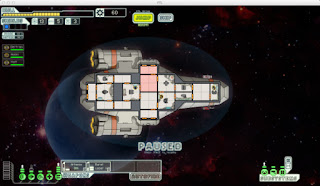
minimalistic top-down graphics and real-time combat. You control all aspects of
your ship from how much power you put into various ship systems to where you
station your crew (they add bonuses as they become more proficient at a job –
faster weapon power up, etc.) and how you upgrade your ship. The items you most have to manage are fuel, missiles, drone parts and scrap - the currency of the future. The controls are point
and click and easy to learn and you can pause when necessary – which it is if
your ship has been boarded, has a hull breach and is on fire – to help you
think about where to move crew or what part of an enemy ship to target.
The basic elements of the game have you jumping (using FTL
drives) to various spots in a given star sector. At each stop you may run into
hostile ships, potential quests, black market stores or other challenges or
dangers. At each you will have a series of choices to make that may help or
hurt your overall goal to escape the Rebel fleet and reach the Federation. With
each jump you make in a sector, it will (hopefully) take you closer to the exit
point (where you can jump to the next sector) and away from the Rebel fleet
(shown on the jump screen as a growing danger area you want to avoid – read you
fight enemy ships every jump).
FTL doesn’t waste
much energy on the graphics, but the sound is great and the game play is really
engaging. It is similar to rogue-like games (Rogue, NetHack, etc.) in
that death of your ship and crew is permanent. I found that it made me think
fondly of NetTrek and similar minimal
graphics starship games of the past. There are also Stats and Achievements to
help you track how well you have done on each game. There are also multiple
ship designs that can be unlocked by various achievements. I have played six
games so far and unlocked one new ship design and haven’t come close to winning
the game on normal, succumbing to a different death each time.
FTL is hard, fun
and re-playable and at $10, you should go out and get it. If you wonder if FTL is right for you, watch the video
above for a little while to get a feel for how it works and how quickly things
can go from great to running at the edge of your seat. FTL gets 4 Mick Happies. Safe travels in the darkness of space.
Labels:
Computer Game,
Faster Than Light,
FTL,
game,
Mac,
NetHack,
NetTrek,
PC,
Rogue,
Rogue-like,
Space,
Steam,
Subset Games
Subscribe to:
Posts (Atom)